Evening Blue Under Three Arches
Before & After
About This Project
This two-story sits on open ground outside Bellingham with a signature the whole design hangs on: arched windows in nearly every gable. It's a beautiful detail — and, as Michael's inspection found, the detail the original builders handled worst. There was no z-flashing above the arches at all. Elsewhere the plank joints had been caulked shut despite having joint flashing behind them, water-weep gaps were missing above the z-flashing that did exist, and the siding was hung with pin-back nails instead of proper fasteners.
The owner had been quoted a year earlier and came back ready to go; we honored the old number with a $589 update, wrote the scope, and got to work. And where the inspection found healthy components — both sliding glass doors had plenty of life left — they stayed out of the proposal entirely. Nobody should pay to replace what isn't broken.
Three Arches, Done the Right Way
Arches can't be flashed with straight metal, which is why so many get no flashing at all. Ours got two upgrades: Astro flexible PVC z-flashing, curved to each arch for real water shedding, and AZEK PVC trim heat-formed with our heat-blanket system into single continuous curves — no stacked seams, no charge, because it's simply the correct way to waterproof an arched window.
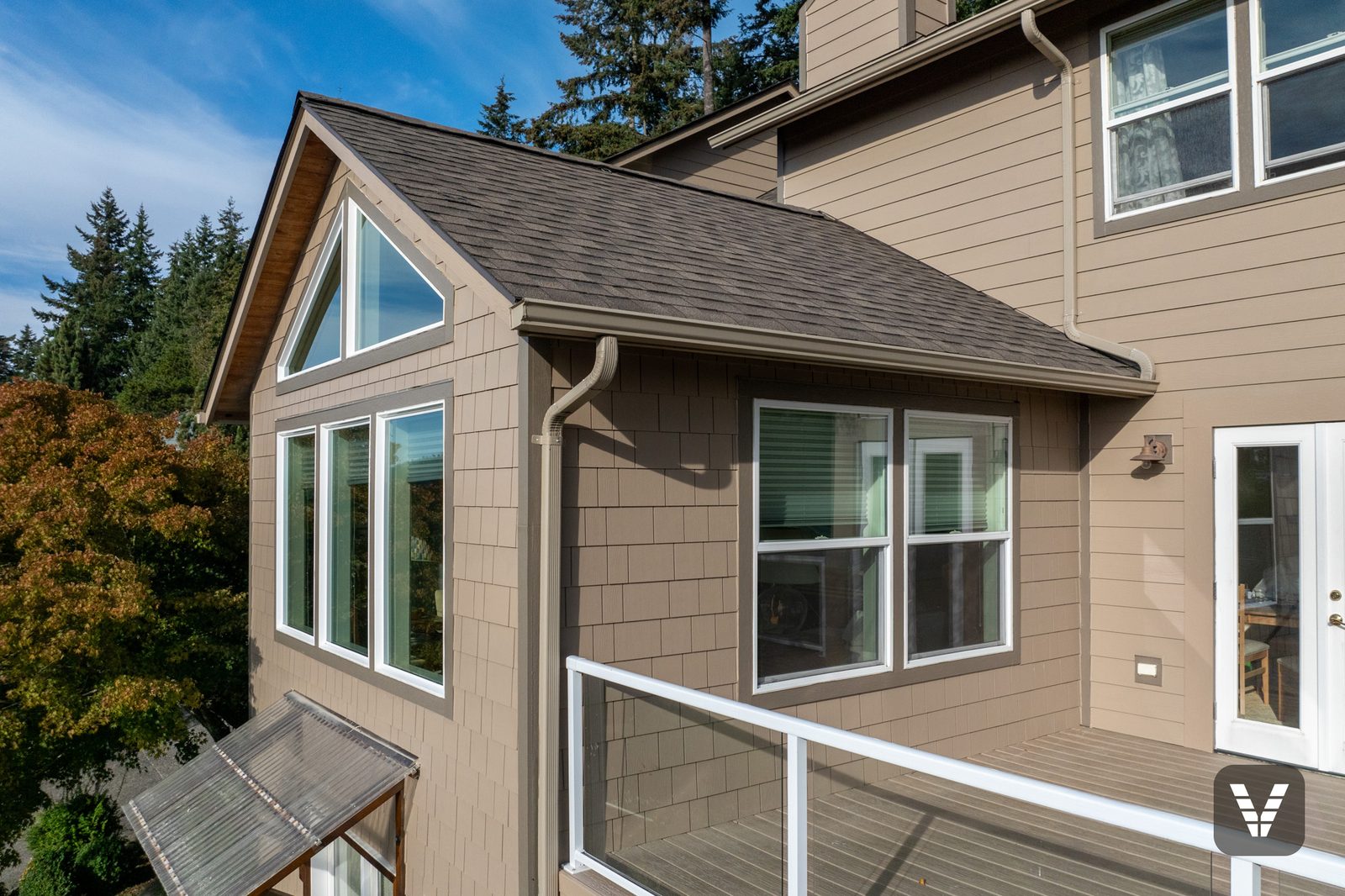
Three of the windows themselves were replaced with Milgard V400 Tuscany units: a half-round for the arch, a half-vent with clean perimeter grids, and an eight-foot picture window. The owner trimmed the flat grids from two of them to save cost — his call, offered plainly — and the third keeps a custom grid pattern matched to the original. Around everything: Evening Blue HardiePlank at a 7-inch reveal, Arctic White HardieTrim with the home's band and belly boards rebuilt, a joint flashing behind every seam, and no caulk at the plank joints — the mistake we'd just finished undoing.
The Change Order Nobody Wants
Mid-project, the tear-off found the thing every homeowner dreads: rot that had traveled past the sheathing into the wall framing itself — something we see on roughly one home in twenty. We wrote it up as a change order with annotated photos, and did what we always do with hidden-repair change orders: we told the owner he was free — encouraged, even — to get other bids for the framing work. We never want to be a homeowner's only option on a repair nobody planned for.
He chose to keep us on, so we priced it very competitively to keep his project moving without interruption: interior drywall demolition included, no deposit asked. Our crew ground out the compromised wood, sistered new studs alongside the old, and his self-provided insulation went in at no charge. And when the work wrapped, the final invoice came in under the change-order estimate. Surprises are part of old walls. Surprise bills don't have to be.
The Finished Look
Deep Evening Blue against open sky, white arches catching the light on every gable, and the brown-era leftovers — eaves, rakes, the porch beam, even the electrical boxes — sprayed to match so nothing interrupts the color. The worst stretch of roof fascia was replaced free with full-length lumber, every vent went to pre-finished metal, and the house that had the neighborhood's best window shapes finally has the envelope to deserve them.